

 News
News
Classification of array antennas.
Estimated reading time: 15 minutes
Array antennas are typically categorized based on the arrangement of their individual units.
Linear array: An array of antenna elements arranged along a straight line, with unit spacing that can be equal or unequal. It can be further divided into edge-illuminated arrays and end-illuminated arrays based on the direction of concentrated radiation energy.
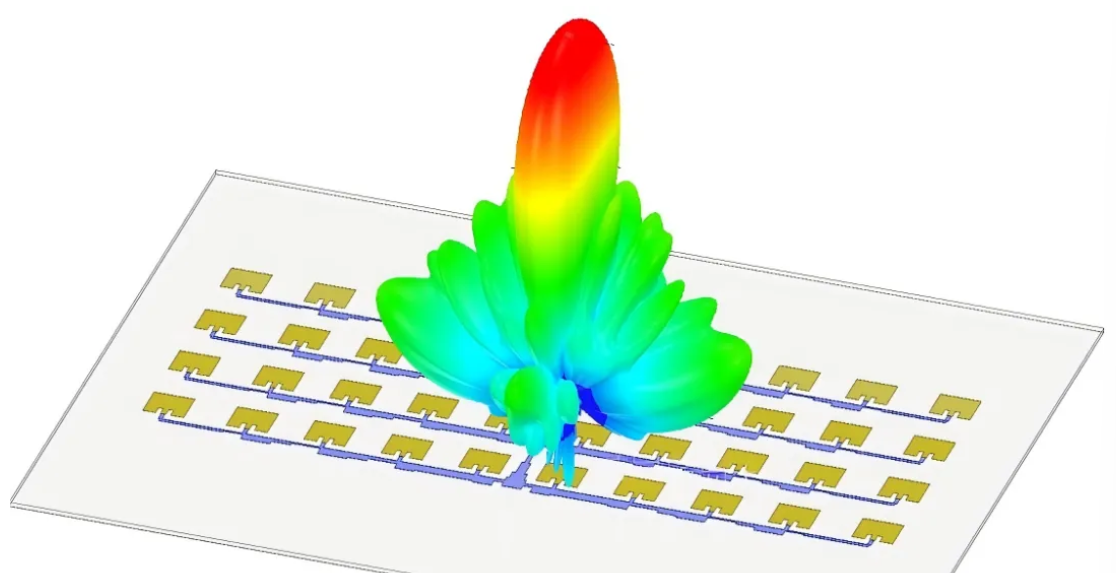
Planar array: An array of antenna elements arranged at the centers of a single plane. If all the elements in a planar array are arranged in a rectangular grid, it is called a rectangular array; if all the element centers are located on concentric circles or elliptical rings, it is called a circular array. Planar arrays can also have arrays with equal or unequal spacing.
Conformal arrays: arrays of antennas that are attached and conform to the shape of the carrier. Cylindrical-surface arrays, spherical-surface arrays, and conical-surface arrays are all examples of conformal arrays.
Array antenna unit configuration.
Linear antenna array elements: dipole types, monopole types, ring-shaped elements (such as slot antennas), and spiral elements.
Diaphragm-type elements: horn antenna elements, open-slot waveguide elements, microstrip patch elements.
Hybrid and specialized elements: Yagi-Uda units, logarithmic-periodic dipole array units, medium-resonance antenna units, metasurface/metamaterial units.
The theoretical basis of array antennas.
① Principle of Interference and Superposition of Electromagnetic Waves: Array antennas can create radiation characteristics that differ from those of conventional individual antenna units. One of the primary reasons for this is that the electromagnetic waves emitted by multiple coherent radiation units interfere and superimpose on each other in space, with some areas experiencing increased radiation and others experiencing decreased radiation. This results in a redistribution of the constant total radiation energy across different spatial regions.
② The Directional Diagram Product Theorem: Under far-field conditions, the overall normalized directional function of an antenna array composed of multiple identical elements, excited with fixed amplitude and phase, and arranged in fixed geometric positions, can be decomposed as follows:
Primary factor F(θ, φ): The directionality of a single unit in free space (including the unit’s polarization and orientation).
Array factor AF(θ, φ): This is determined solely by the geometric layout, spacing, excitation amplitude, and phase of the array, and is independent of the specific shape of the elements.
That is, the composite overall direction diagram D(θ,φ) = F(θ,φ) · AF(θ,φ).
Analysis of array antennas.
The analysis of an array antenna involves determining its radiation characteristics under the assumption that four parameters are known (the total number of elements, the spatial distribution of elements, the distribution of excitation amplitudes for each element, and the distribution of excitation phases for each element). These characteristics include the array antenna’s direction diagram, half-power beamwidth, directionality coefficient, side lobe level, and so on.
Array antenna integration.
The synthesis of an array antenna is the reverse problem of its analysis, namely, to synthesize the four parameters of an array antenna (the total number of elements, the spatial distribution of elements, the distribution of excitation amplitudes for each element, and the distribution of excitation phases for each element) under given radiation characteristics, so that certain radiation characteristics of the array meet specified requirements, or so that the array’s direction pattern closely approximates a predetermined direction pattern.